
Laser 128 - my first computer.
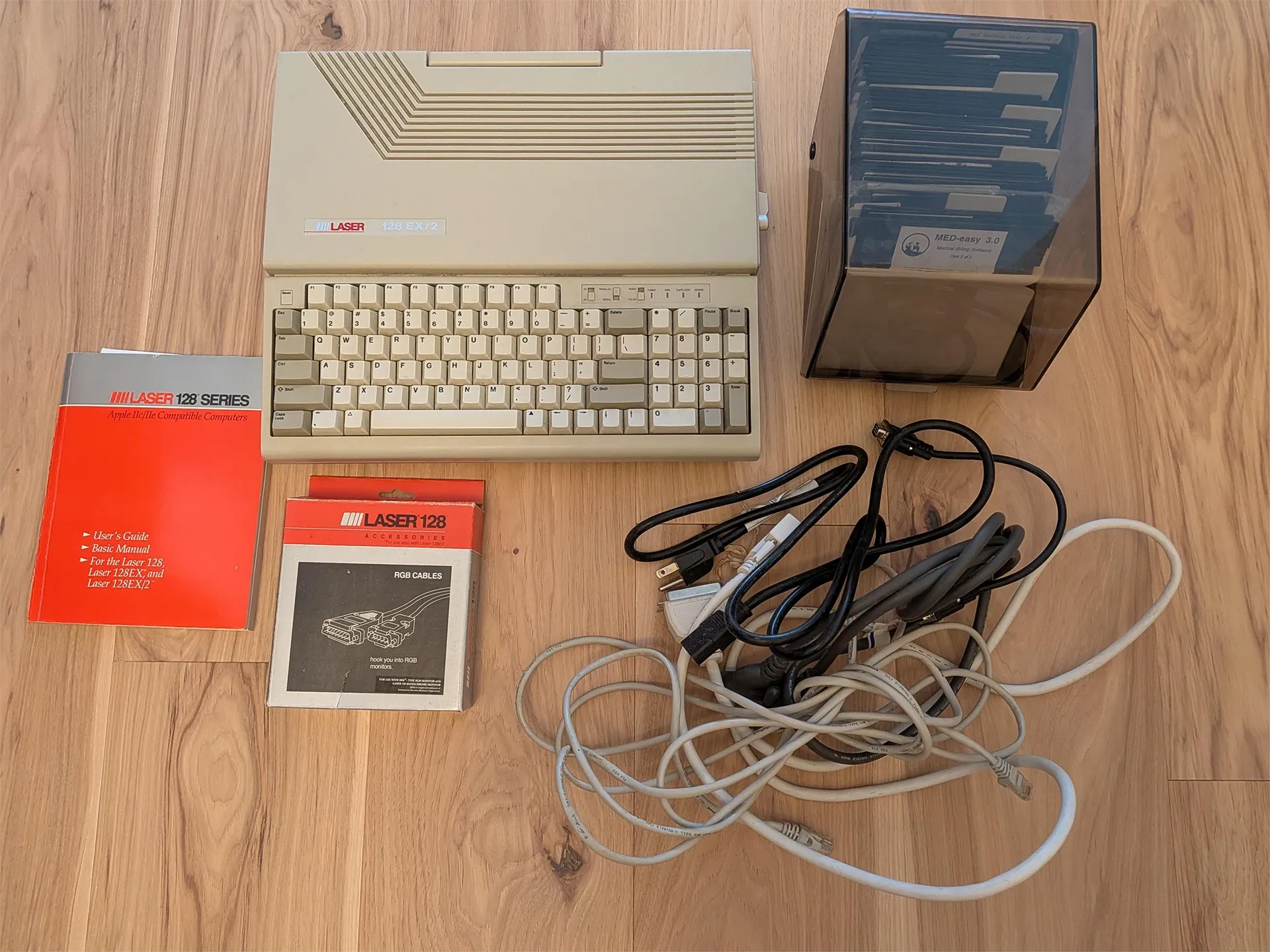
The Laser 128 computer was an Apple II-compatible home computer manufactured by Video Technologies Ltd in Hong Kong and sold in the 1980s. It was available via mail order and in some retail stores like Sears. In spite of the name, there wasn’t anything optical about it. The name “laser” just sounded like high technology in the 1980s.
The Laser 128 was an Apple II clone most noteworthy for not violating any of Apple’s copyrights. It blended some of the features of both the Apple IIe and IIc computers, improving significantly on the IIc in the process.
Laser 128 computer overview.
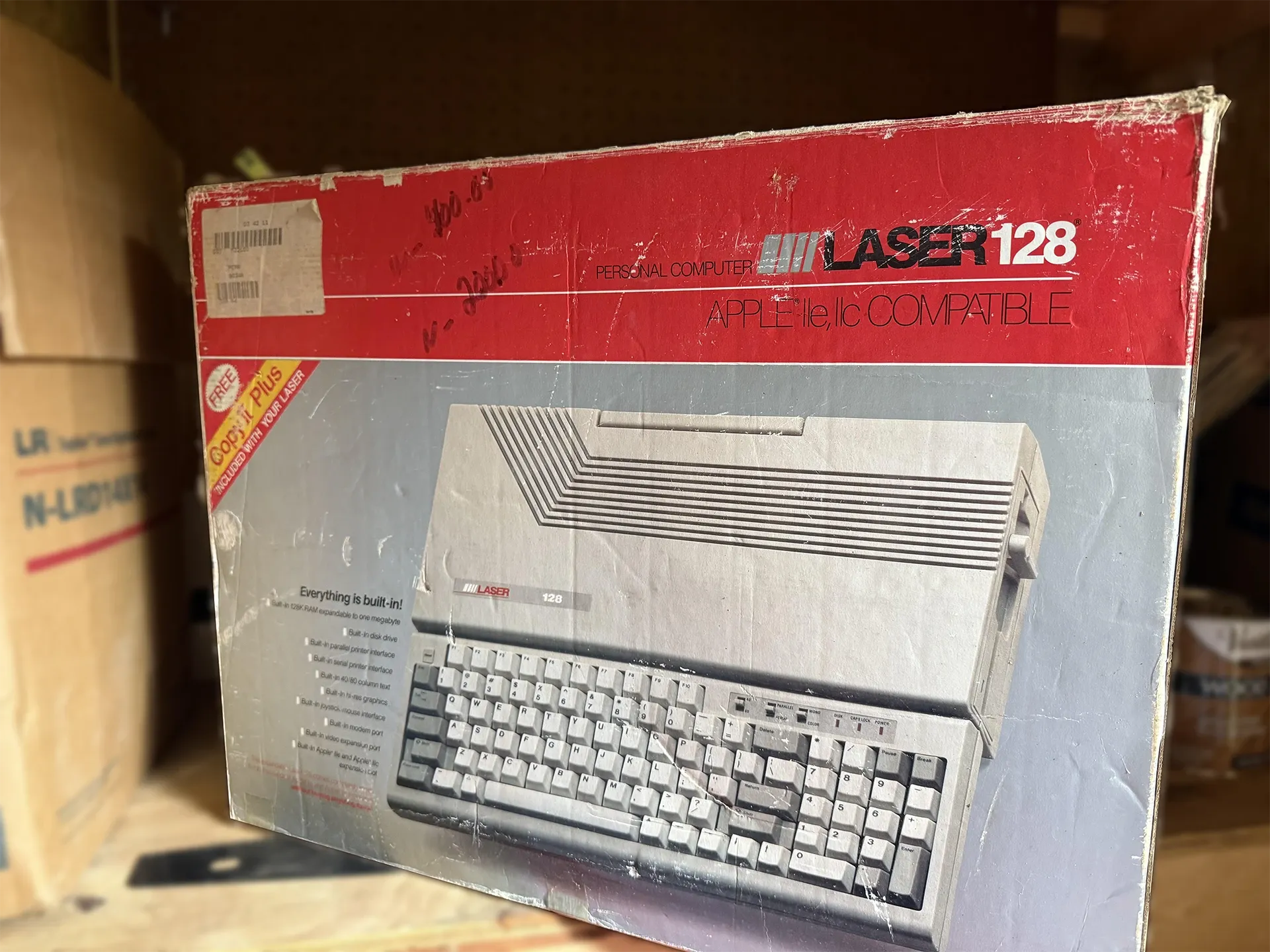
Like its name suggests, the Laser 128 computer shipped with 128 KB of RAM like the Apple IIc. Its form factor resembled the IIc, including the handle and single-piece design with the disk drive on the right side and the drive, keyboard, and CPU all integrated into a single unit. Its ports on the back mimicked the IIc. It was just a bit wider and thicker, due to the presence of a numeric keypad and expansion slot. The power supply uses the same pinout as the IIc.
Under the hood, the Laser 128 more closely resembled a IIe than a IIc, but the end result was highly compatible with both machines.
There were more than 160 different Apple II clones produced throughout the world during the Apple II’s heyday. Most were produced in other countries where Apple had little or no legal recourse to stop them. The Laser 128 was one of very few that challenged Apple on its home turf and held up to Apple’s legal challenges.
Laser 128 date of release and price.
Some computer identification and reference books state the Laser 128 came out in 1984. I think this is incorrect. I can’t find mention of it in any magazine prior to early 1986, and Mike Brown, the president of its US distributor, said they chose the name to sound like the Commodore 128. The Commodore 128 came out in 1985. At the very least, the Laser 128 was released in 1986 in the United States, because that’s when Vtech secured the rights to import it.
Initially the Laser 128 retailed for $479, but it frequently sold for less. Central Point Software sold it for $399 by mail order, as did Computer Direct, a Chicago-based mail order house from the 1980s. Sears featured it in its 1988 Christmas catalog priced at $399. The Commodore 128D on the page before sold for $499.
The Laser 128 computer’s appeal was Apple compatibility at a Commodore price. To that end, its distributors even advertised it in magazines for Commodore owners. It seems to have worked. The Laser 128 computer is hardly common today, but it sold well enough that software publishers started testing their software on it to make sure it worked. It’s unclear how many Commodore owners they converted, but if nothing else, they put an end the the $299 Spartan accessory that made the C-64 compatible with an Apple II+.
There were two additional models released later, 1987’s Laser 128EX and 1988’s Laser 128EX/2. These featured faster 3.6 MHz CPUs, more video memory, and, in the case of the EX/2, a 3.5-inch disk drive and MIDI port.
Laser 128 compatibility.
Early reviews in 1986 found the Laser 128 ran most of the major Apple II titles. Compatibility ranged from 85 to 95 percent, and some titles would load and run but the graphics were glitchy. Some publications counted the program glitchiness as a success, some as a failure. But the competing Franklin Ace 2000 series, which was also Apple compatible, only worked with about 50% of the titles on the market.
Franklin had copied the Apple ROMs and operating system, which resulted in a famous lawsuit from Apple, which Franklin lost. The Ace 2000 was a clean-room design, and sported a much lower degree of compatibility as a result. Vtech licensed the same 6502 Basic from Microsoft that Apple did. Reserving the right to do that was Microsoft’s custom, so there was nothing underhanded there. Vtech then performed a Compaq-style clean room implementation of the rest of the Apple system ROM, and shipped the computer without an operating system. This allowed Vtech to offer a higher degree of compatibility than Franklin and prevented Apple from keeping the machine from the market. Many Apple programs relied on the Basic ROM, so having the routines all at the same addresses ensured they could run.
The Laser 128 fell short of 100% compatibility, but the various Apple models weren’t quite 100% compatible with each other either. The key was being compatible enough.
Hardware compatibility.
Hardware-wise, the Laser 128 was mostly compatible with IIe and IIc accessories. Not all IIe expansion cards worked in its expansion slot, since the IIe’s slots weren’t completely interchangeable. But cards that didn’t care what slot they were plugged into worked fine. Apple’s 3.5-inch disk drive wouldn’t work on the Laser 128’s built-in disk drive port, but it would work with a controller plugged into its expansion slot or separately-sold expansion chassis.
Critical reception of the Laser 128 computer.
The Laser 128 generally received good reviews. The Apple magazines generally criticized its styling, calling its appearance utilitarian and homely. A later revision dressed it up a bit, adding angled vents and a place to hold a pen above the keyboard, but it still didn’t match Apple’s industrial design. Reviewers liked its numeric keypad and function keys, but didn’t necessarily take to the feel of its keyboard. At least some examples of the IIc had a nice Alps keyboard with a good tactile feel that the cheaper Laser 128 keyboard couldn’t match.
Critics didn’t like the Laser 128 computer’s external expansion slot, since it left the circuit board exposed and invited accidents. The FCC didn’t like it either, and that led to the optional $89 expansion chassis. The expansion chassis provided two slots and enclosing the cards. But the expansion chassis was bulky, boxy, and unwieldy. It worked, but it left a big rectangular box hanging off the left-hand side of the machine.
While the Laser 128 computer didn’t look or feel quite as nice as an Apple IIe or IIc, none of the magazines of the time questioned its value. It cost half as much and worked with all of the major titles people bought Apples to run.
Apple took the Laser 128 computer seriously. After they couldn’t stop it in the courtroom, they responded with the Enhanced IIe and the IIc+. The Enhanced IIe added a numeric keypad, while the IIc+ added a 3.5-inch disk drive and faster processor.
Reliability.
The Laser 128 was highly compatible, but didn’t quite match Apple’s reliability. Commodore was able to sell machines for half the price of Apple because they manufactured so many of their chips themselves. Vtech was buying chips from the same suppliers Apple did, so they didn’t have Commodore’s margins. To keep costs down, Vtech had to skimp on the quality of other components like capacitors and resistors. Where Commodore was designing with the goal of a specific life expectancy, Vtech had to go with the low bidder.
There’s no question the Laser 128 was always less common than the Apple IIc, but a larger percentage of Apple IIc computers survived as well.
How the Laser 128 computer was sold.
Central Point Software sold the Laser 128 computer direct, priced about $80 below retail. However, there were other dealers who also sold it, and if you find a Laser 128 computer for sale, the other peripherals with it can give you some idea of where it might have been purchased.
Sears sold the Laser 128 computer in its catalogs alongside its own dot matrix printer and a couple of different models of Magnavox monitors. If you see a Laser 128 with either a Sears-branded printer or a Magnavox monitor, that’s an indicator the unit may have come from Sears.
Computer Direct sold the Laser 128 in various bundles over the years, sometimes with a 9-inch or 12-inch monochrome monitor, and with a printer. If you see a Laser 128 with a small thermal printer with a badge on it that says “Big Blue,” that’s almost certainly a Computer Direct bundle. Computer Direct also sometimes bundled it with other printers, such as a dot matrix printer it badged simply as “NLQ 180.”
As collectors, we frequently know little or nothing about the history or provenance of the machines we acquire. The peripherals we find with the Laser 128 can give us more clues than most of our finds do.
Later models: Laser 128EX and Laser 128EX/2. VTech followed up with the Laser 128EX in 1987 and EX/2 in mid-1988 that built on the Laser 128’s capabilities.
The Laser 128EX added a faster CPU running at up to 3.6 MHz, up to 1 megabyte of RAM, and making additional changes to accommodate the faster CPU. Due to the changes from the earlier Laser 128 models, it uses a different motherboard.
The Laser 128EX/2 added even more. In addition to the faster CPU and increased memory, it included a realtime clock, MIDI port, the ability to produce digital or analog RGB video at 15 KHz, and replaced the 5.25-inch floppy disk drive with a 3.5-inch floppy drive. The 3.5-inch floppy drive made the machine appear more modern, but at the expense of compatibility as much more Apple II software was available on 5.25-inch disks than 3.5. It was also very common for software that shipped on 3.5-inch disks to assume it was booting on an Apple IIgs, and required a workaround to make it work on an EX/2, if it could be made to work at all.
[!NOTE] This arcticle was originally published on David Farquhar’s blog and is republished here with permission.